Home » Blog » DMU College of Pharmacy and VCU School of Pharmacy Bring U.S. Expertise to DMU Master of Clinical Pharmacy Students
DMU College of Pharmacy and VCU School of Pharmacy Bring U.S. Expertise to DMU Master of Clinical Pharmacy Students
November 9, 2026
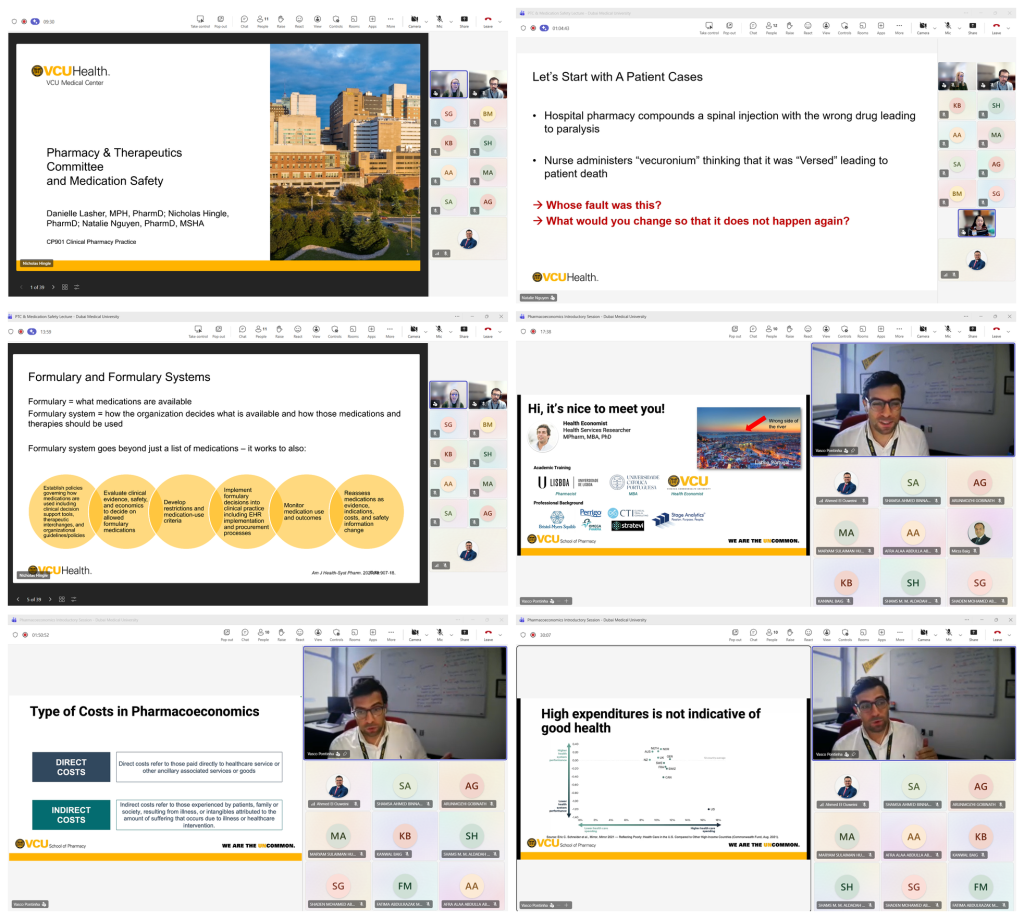
Dubai, 9 November 2026. As part of its growing academic collaboration with Virginia Commonwealth University (VCU) School of Pharmacy in the United States, Dubai Medical University (DMU) College of Pharmacy hosted two online guest lectures for first-year students in its Master of Clinical Pharmacy (MPharm) program. The sessions were part of the Clinical Pharmacy Practice course. They gave students a direct look at how health economics, formulary decisions and medication safety are handled in leading U.S. health systems.
Health Economics and Outcomes Research: Why, How, and Applications
On October 9, 2026, Dr. Vasco M. Pontinha, PhD, Assistant Professor at VCU, gave a lecture introducing Health Economics and Outcomes Research (HEOR) and pharmacoeconomics. Key points included:
Why HEOR matters: Populations are aging, a small group of high-need patients accounts for a large share of spending, and new treatments keep arriving at higher prices. Health systems therefore have to make hard choices about how to use limited resources.
Value in healthcare: Students looked at value as clinical outcomes, patient satisfaction and health-related quality of life weighed against cost. The lecture stressed opportunity cost: every resource spent on one patient is no longer available for another.
Matching questions to analyses: Questions about efficiency (Treatment A or B?) call for cost-effectiveness analysis. Questions about equity and coverage call for budget impact analysis. Questions about profitability call for return-on-investment analysis.
Decision analysis in practice: Dr. Pontinha used everyday examples and a decision tree for anticoagulation after hip replacement. With these, he walked students through building a model, estimating probabilities, calculating expected outcomes and interpreting the incremental cost-effectiveness ratio (ICER) against willingness-to-pay thresholds per quality-adjusted life year (QALY).
Rigor and perspective: Students learned how ISPOR guidance standardizes how economic models are built and reported. They also covered how direct medical, direct non-medical and indirect costs are chosen depending on whether the study takes a payer’s or society’s perspective.
The Pharmacy & Therapeutics Committee and Medication Safety
On November 2, 2026, Dr. Natalie Nguyen, PharmD, MSHA, together with her VCU Health colleagues Dr. Danielle Lasher, MPH, PharmD, and Dr. Nicholas Hingle, PharmD, gave a lecture on formulary management and medication safety in the hospital setting. Highlights included:
Formulary systems: The lecture covered open, closed and tiered formularies. It explained that a formulary system goes beyond a list of drugs: it sets policy, evaluates evidence, applies restrictions, puts decisions into the electronic health record, and keeps monitoring and reassessing medicines over time.
The P&T Committee: Students learned about the committee’s makeup, its subcommittees and clinical panels, and its core responsibilities. Formulary decisions are reviewed across four areas: clinical, safety, operational and financial. VCU Health’s own P&T structure served as a real-world example.
The pharmacist’s role: Pharmacists conduct evidence-based drug evaluations and pharmacoeconomic reviews, lead medication-use evaluations and therapeutic interchange, and drive stewardship efforts such as IV-to-oral conversion and adoption of biosimilars.
Medication Safety Committee: The lecture presented medication errors as failures of the system rather than of individuals. It covered Just Culture principles, how events are categorized and analyzed, root cause analysis, and favoring high-leverage safeguards such as forcing functions over reminders to “be more careful.” It also described the pharmacist as a medication safety leader.
Building Global Partnerships
DMU College of Pharmacy thanks Dr. Pontinha, Dr. Nguyen, Dr. Lasher and Dr. Hingle for generously sharing their time and expertise. “Exposing our MPharm students to best practices from leading U.S. institutions is central to preparing clinical pharmacists who can lead formulary, value-based and medication safety initiatives in the UAE’s healthcare system,” said Dr. Ahmad El Ouweini, Interim Program Director of the Master of Clinical Pharmacy program. “We are grateful to our colleagues at VCU and look forward to expanding this collaboration.”